
TL;DR: Your AI agent forgets everything between sessions because it has no structured memory. Knowledge Graphs fix that. They give your agent persistent, connected knowledge it can reason from. Gartner says organizations using structured knowledge layers with LLMs cut AI error rates by 60%+. This post covers the three layers (Ontology, KG, Context Graph), the 5-level maturity ladder, which graph databases to pick, which memory frameworks to use, and how to start in 90 days.
Why Do Most Enterprise AI Pilots Fail?
Because the bottleneck was never the model. It was memory.
Gartner predicted at least 30% of generative AI projects would be abandoned after proof of concept by the end of 2025.
McKinsey’s 2025 State of AI survey counted 88% of organizations using AI, up from 78% the year before. But nearly two-thirds had not extended AI beyond experimentation. Poor data quality and missing context were the top reasons projects stalled. Cloudera and Harvard Business Review found that only 7% of organizations said their data was completely ready for AI.
Your agent can’t reason about your business if it can’t see how things connect. The model is fine. The data infrastructure underneath it is not.
What Is the AI Maturity Ladder?
Most enterprises evolve through five levels. Most get stuck between Level 2 and Level 3.
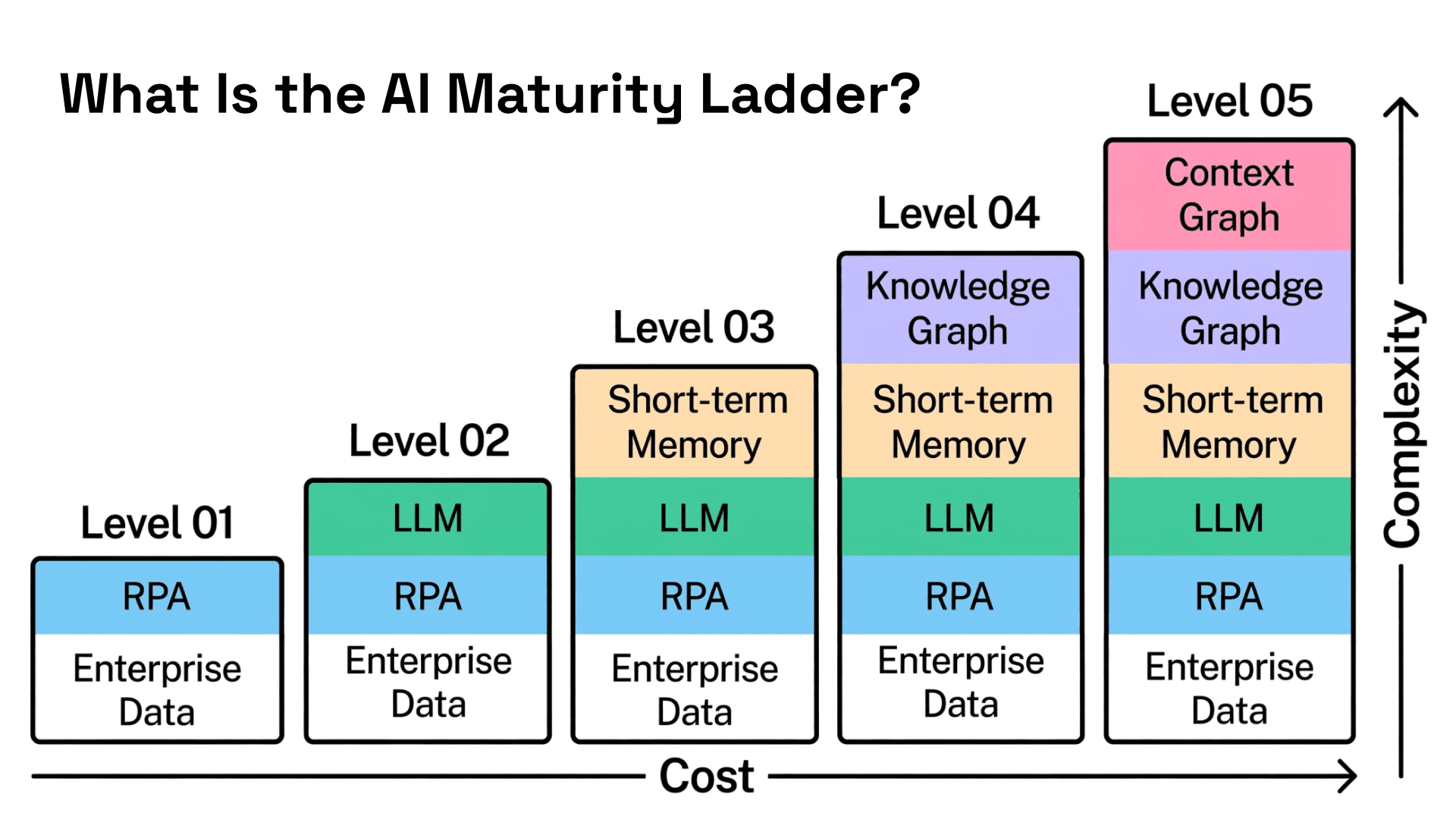
Level 01: RPA + Enterprise Data. Basic automation. Rules engines, scheduled jobs, scripted workflows. No intelligence.
Level 02: Add LLM. Your agent can reason, but has no memory. Each query starts from zero.
Level 03: Short-term Memory. Agent recalls within a session, forgets after. Every Tuesday feels like Monday to your AI.
Level 04: Knowledge Graph. Persistent structured memory. Cross-session recall. Your agent remembers that this customer has this contract governed by this policy.
Level 05: Context Graph. Full context assembly across all enterprise data. Decision traces, temporal validity, governance baked in. Gartner expects over 50% of enterprise AI agent systems to rely on context graphs by 2028.
Gartner also predicts 40% of enterprise applications will embed task-specific AI agents by the end of 2026, up from less than 5% in 2025. That eightfold increase means the infrastructure question is not hypothetical. It is this year’s budget item.
The gap between Level 2 (chatbot) and Level 4 (agent that knows your business) is the gap between wasting money on AI and getting value from it.
What Are Ontology, Knowledge Graph, and Context Graph?
Three different layers. Most teams treat them as interchangeable. They’re not.
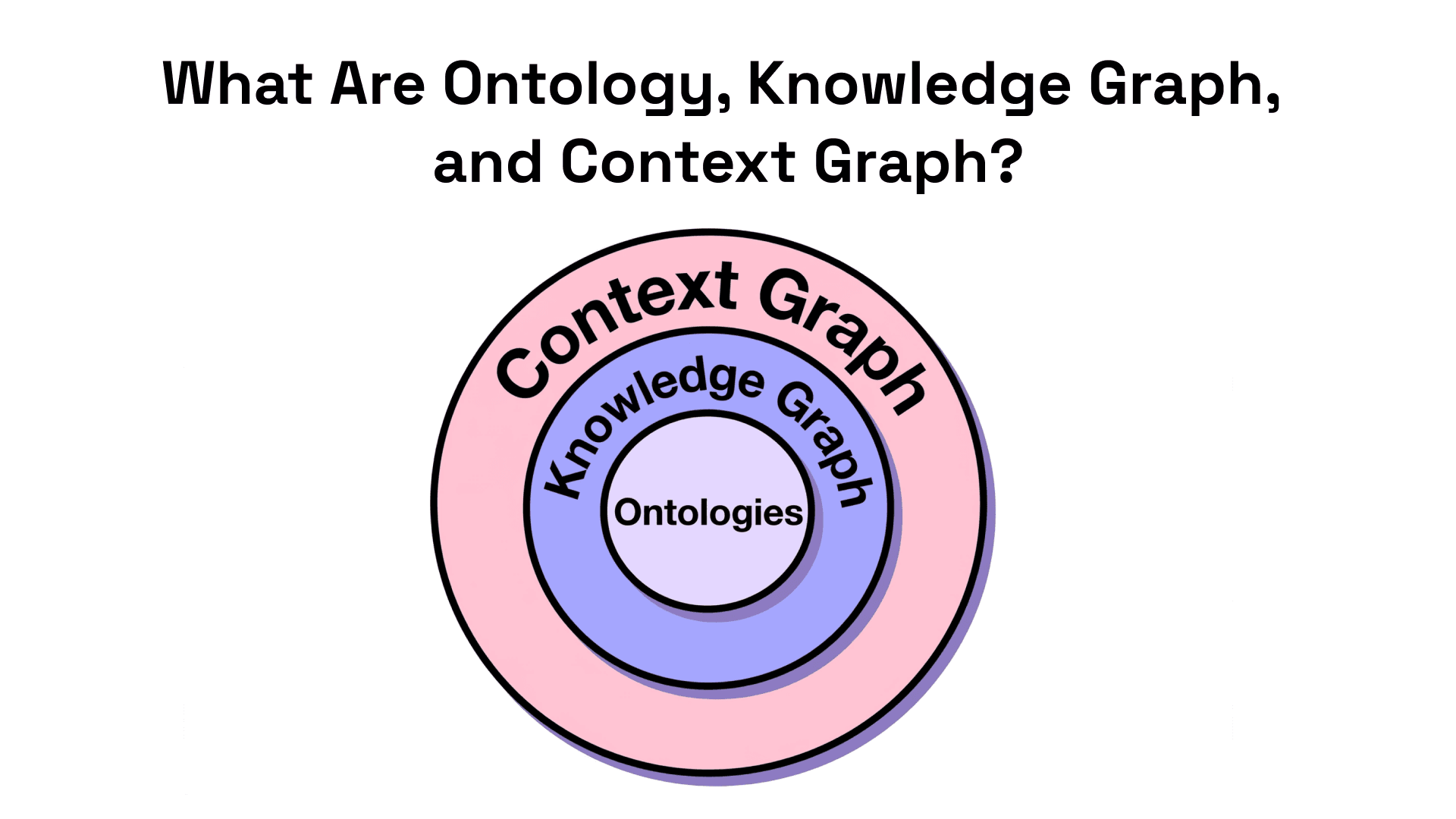
Ontology is your business vocabulary. The rules and relationships your data must follow. BCG describes ontology as “the missing layer in enterprise data architecture.” Without it, your AI has no shared language across departments.
Knowledge Graph is the actual database. It stores your entities (customers, products, invoices, policies) and how they connect (placed(), sent_to(), governed_by()). Entities linked through semantic relationships.
Context Graph is what your agent uses at runtime. It pulls the right slice of that knowledge for the task at hand, layered with decision traces, temporal validity, and governance metadata.
Order matters. Ontology defines it. KG stores it. Context Graph serves it. Gartner reports that organizations using structured knowledge layers with LLMs reduced AI-generated error rates by more than 60% compared to standard RAG systems.
Where Do Knowledge Graphs Actually Work?
The honest picture for 2026 is more focused than the hype suggests. KGs deliver value in four specific areas.
Master data management. KGs that integrate customer, product, and reference data across systems give a unified view that traditional MDM struggles with. Adoption is real and growing.
Compliance and regulatory mapping. Linking regulations, controls, processes, and evidence in graph structure. Enterprises use graph-based approaches in regulated industry engagements.
Fraud detection. Fraud doesn’t show up in isolated data points. Graph traversal surfaces patterns across accounts, devices, IP addresses, and behaviors that relational queries miss.
Supply chain dependency mapping. When disruption happens, a graph answers which finished products depend on which components and regions. Without it, that analysis takes days of spreadsheets.
Where KGs have not delivered: Universal enterprise knowledge integration (too expensive), Generic AI enhancement (graph + ML benefits are use-case specific), Replacing relational databases (they complement, not replace), and self-service knowledge access for business users (query languages are still too technical).
Which Graph Database Should You Pick?
Commercial
· Neo4j - Default choice for most teams. Largest community, Cypher query language, AuraDB managed option, best GraphRAG integrations.
· Amazon Neptune - AWS-native teams. Property graph + RDF modes. Managed service, no infrastructure to manage.
· Azure Cosmos DB - Microsoft shops. Gremlin API for graph queries. Multi-model, globally distributed.
· BigQuery Graph- Google Cloud-based graph modeling natively inside BigQuery. Property graph on top of existing data. Native Gemini and Vertex AI integration.
Open Source
- FalkorDB - Ultra-low latency. Redis-compatible. Native GraphRAG SDK + vector. (Open source / Enterprise)
- Memgraph - In-memory speed, Cypher-compatible. Outperforms Neo4j in write-heavy benchmarks.
- NebulaGraph - Distributed scale. Handles massive graphs across multiple machines. (Open source)
- ArangoDB - Multi-model (graph + document + key-value). Consolidate if you need more than just graph.
- JanusGraph - Linux Foundation backed. Distributed, battle-tested at scale. (Apache 2.0)
- Apache AGE - PostgreSQL extension. No new database to manage. (Apache 2.0)
For most teams starting their first enterprise KG, Neo4j is the default. FalkorDB if latency is your primary constraint. Neptune, Cosmos DB, or BigQuery Graph if you are already cloud-native. PostgreSQL plus Apache AGE if you do not want to manage another database. Do not over-optimize on day one. Pick the one your team can ship fastest.
Which Agentic Memory Framework Should You Use?
Your AI agent forgets everything between sessions. These frameworks solve that.
- Mem0 - Lightweight vector-based memory layer. Fastest path to production. Integrates with LangGraph, CrewAI, OpenAI SDK.
- Zep - Temporal knowledge graph engine. Enterprise-grade memory with decision traces. SOC 2 compliant. Sub-200ms retrieval. Validated by S&P Market Intelligence.
- Letta - Virtual context + core + archival memory. Stateful agents that need long-term persistence across sessions.
- Cognee - Vector + graph + KV store hybrid. Production deployments with mixed memory needs.
Start with Mem0 if you are adding memory to an existing agent stack. It is the fastest path to production. Move to Zep when you need temporal reasoning, governance, and audit trails. Letta when agents need persistent state across sessions like an operating system. The choice matters less than having structured memory at all.
What Three Workflows Do Knowledge Graphs Enable Right Now?
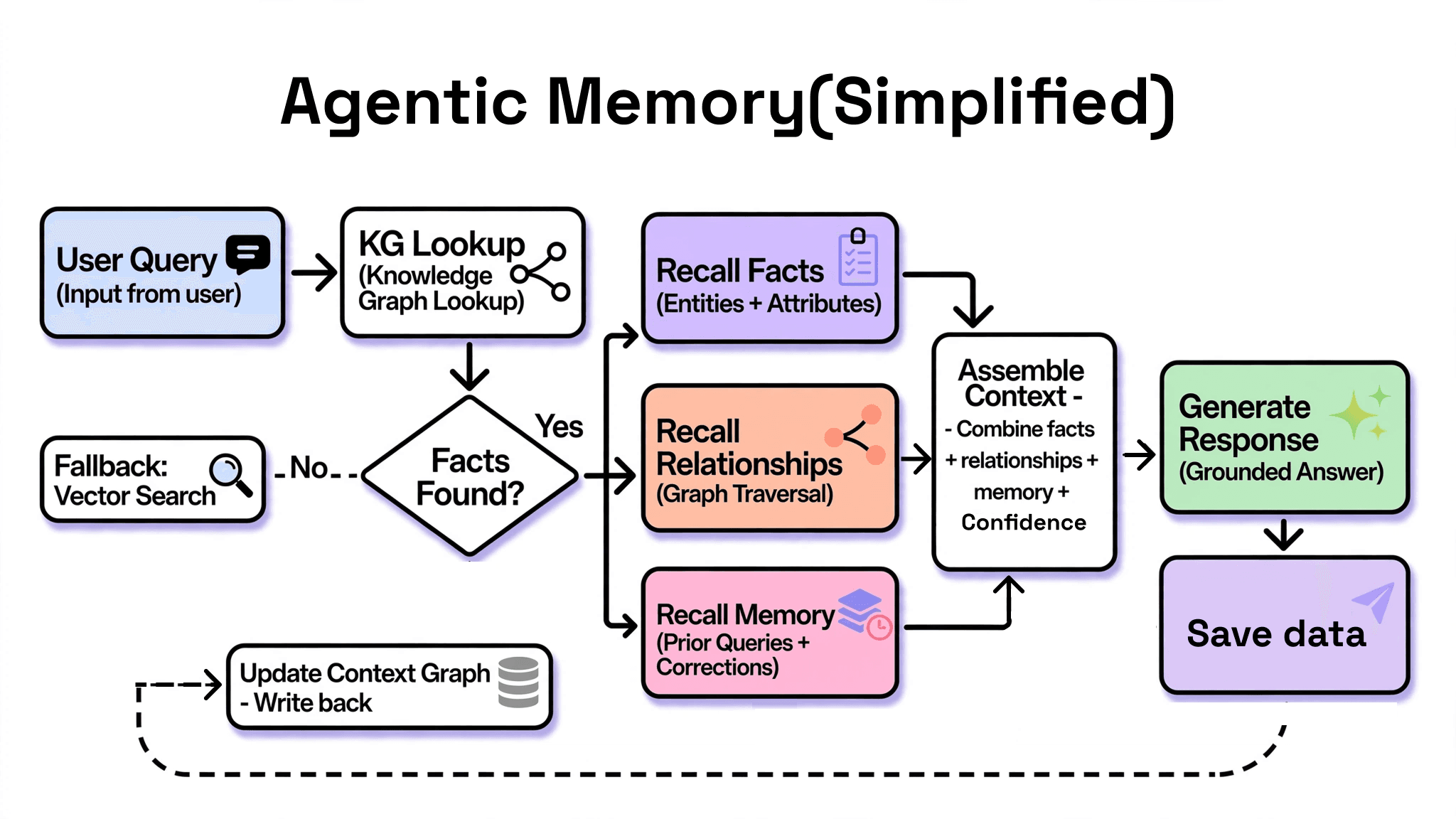
1. Agentic Memory
Query goes to KG lookup, recalls facts, assembles context, generates response. The agent remembers past interactions.
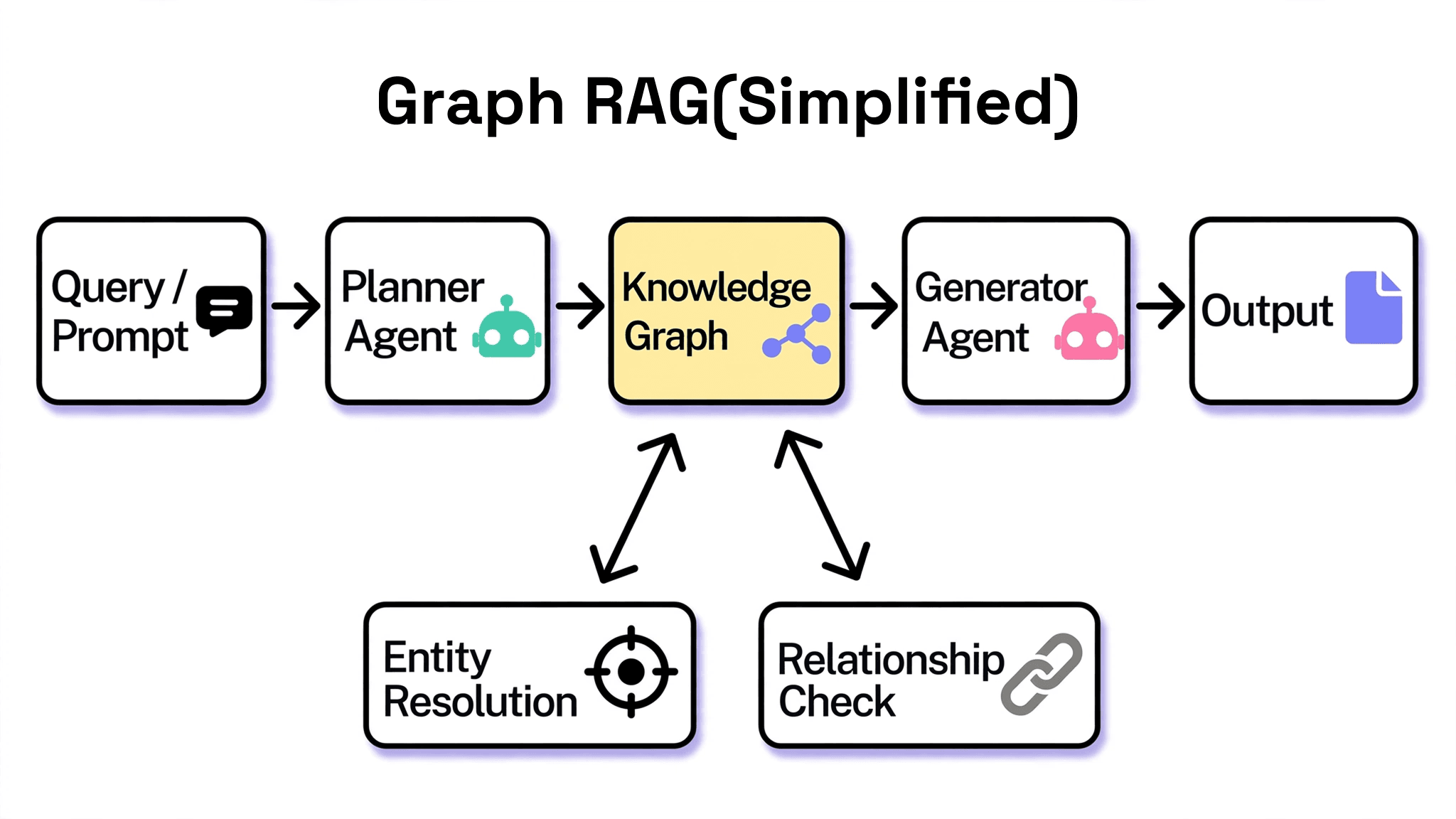
2. GraphRAG
Graph-enhanced retrieval-augmented generation. A planner agent traverses the graph, resolves entities, checks relationships, then generates. Retrieves connected knowledge, not just text chunks.
How Do You Start a Knowledge Graph in 90 Days?
You don’t need a multi-year program. You need a pilot with one clear use case.
Step 1: Define your competency questions. What specific questions must your knowledge graph answer that your current systems cannot? Be specific. “Which customers on the Enterprise Plan filed more than three P1 tickets in the last 90 days?” That is a competency question. “Make AI better” is not.
Step 2: Design the ontology with domain experts. Data engineers understand data structure. Domain experts understand what the entities and relationships mean to the business. You need both.
Step 3: Run entity resolution before loading data. A knowledge graph built on unresolved entities produces incorrect results. The same customer appearing as separate records breaks every traversal.
Step 4: Connect the graph to your AI layer. Build a retrieval layer that combines vector search with graph traversal. Implement guardrails that validate LLM outputs against known graph facts before showing results.
Build vs. buy doesn’t matter if you haven’t built the retrieval layer first.
Frequently Asked Questions
How long does it take to see ROI from a knowledge graph?
A focused lighthouse use case typically delivers initial results in 60 to 90 days. Full production deployment with governance, monitoring, and AI integration usually takes three to six months. Enterprise-wide expansion is an ongoing program, not a single project.
What is the difference between a knowledge graph and a regular database?
A regular database stores records and retrieves them by matching field values. A knowledge graph stores entities and the typed relationships between them. It answers multi-hop questions across connected entities in a single traversal without complex joins.
Do enterprise knowledge graphs replace existing data infrastructure?
No. A KG sits alongside your warehouse, data lake, and operational databases as a semantic layer. It integrates with existing systems rather than replacing them.
What is GraphRAG and why does it matter?
GraphRAG combines a vector database for semantic search with a knowledge graph for structural reasoning. The LLM receives enriched context from both sources and produces grounded, accurate answers instead of hallucinated inferences.
Which graph database should I start with?
Neo4j for most teams. FalkorDB if latency is your constraint. Neptune or Cosmos DB if you are already cloud-native. PostgreSQL plus Apache AGE if you do not want to manage another database.