
TLDR:
The Agentic Development Life Cycle (ADLC) is an AI-augmented software development framework where AI agents actively participate in building, testing, and optimizing software systems.
Traditional SDLC is human-first and deterministic; it assumes predictable workflows, manual execution, and linear progress. This makes it reliable, but also slow and resource-intensive.
ADLC introduces AI agents into the development process, transforming how software is built. Instead of relying entirely on human effort, agents accelerate development by handling execution, iteration, and optimization — allowing teams to move faster and scale output dramatically.
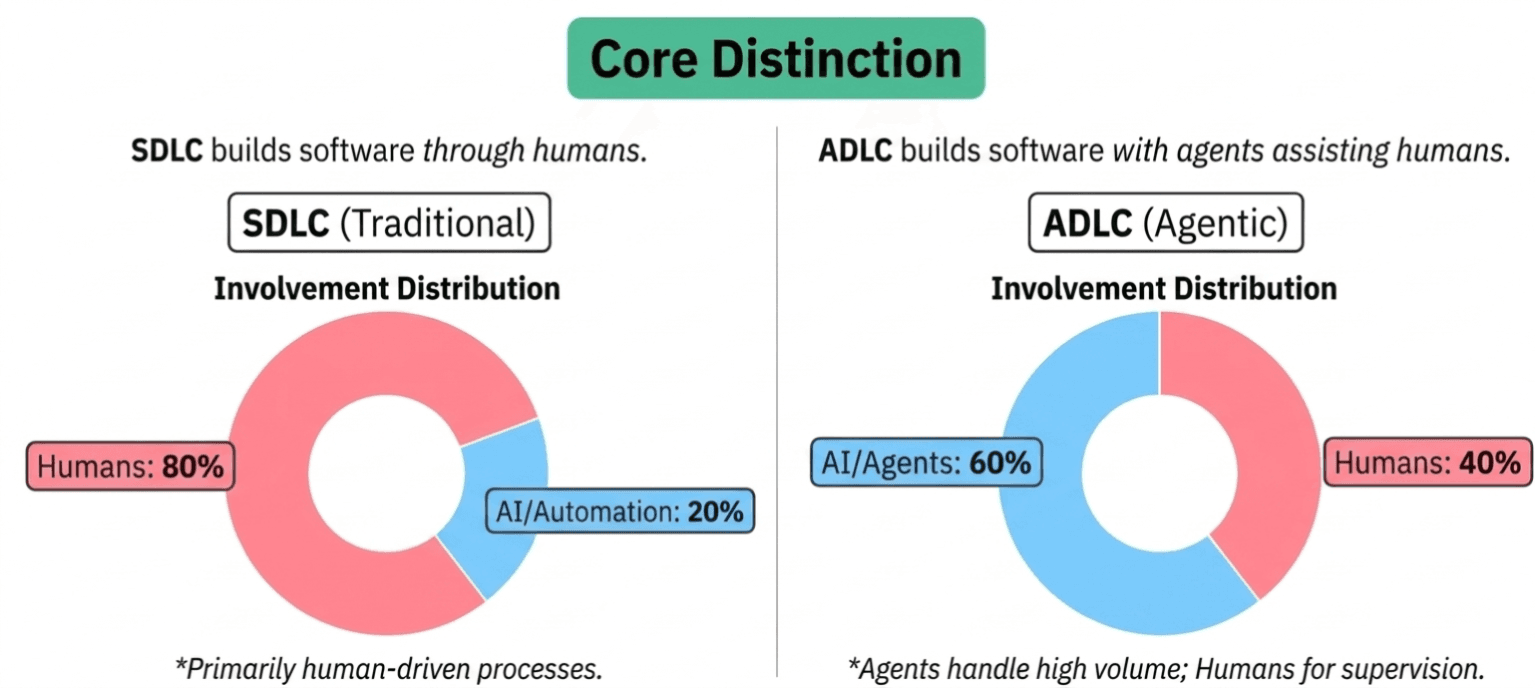
Core distinction:
SDLC builds software through humans.
ADLC builds software with agents assisting humans.
SDLC delivers control. ADLC delivers speed and scale.
Why SDLC Fundamentally Slows Down Modern Software Development
Traditional software development was designed for a world where humans write, test, and deploy everything manually. That model still works, but it does not scale efficiently in an AI-driven environment.
The limitation isn’t that SDLC is “wrong.”It’s that it is human-constrained.
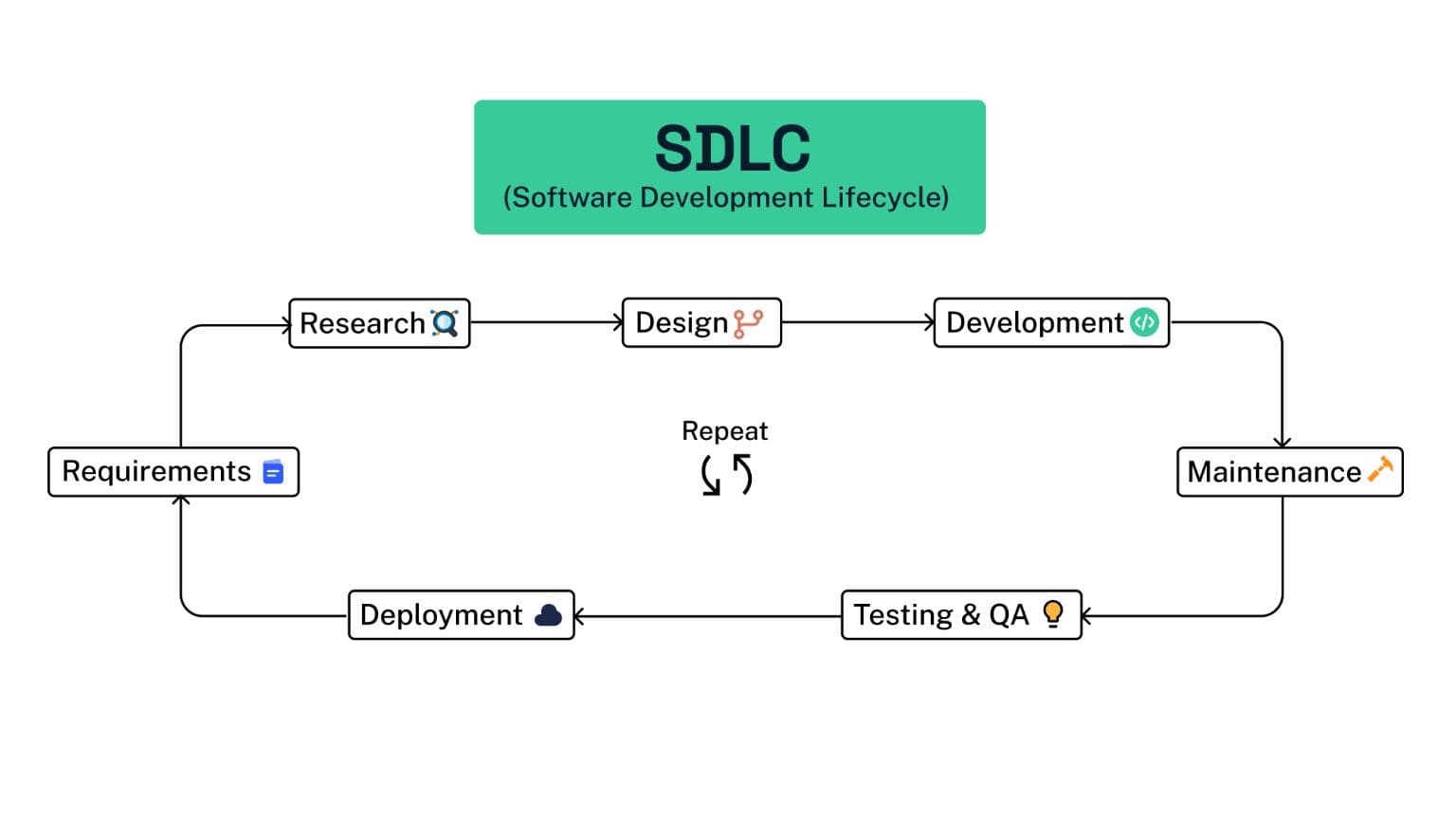
1. Requirements
- Purpose: Define what the software needs to achieve and the problems it should solve.
- Process: Business analysts and stakeholders gather, analyze, and document the functional and non-functional requirements. This phase ensures clarity on the project’s objectives and scope.
2. Research
- Purpose: Identify the best technologies, tools, and methodologies for the project.
- Process: Developers and architects research available technologies, evaluate their feasibility, and assess potential risks. This phase helps in selecting the optimal approach for development.
3. Design
- Purpose: Create a blueprint for the software.
- Process: System architects and designers develop the software architecture, user interface (UI), user experience (UX), and database design. This phase focuses on how the software will function and appear.
4. Development
- Purpose: Build the software based on the design specifications.
- Process: Developers write the code, integrate different components, and ensure the software aligns with the design. This phase involves coding, debugging, and continuous integration.
5. Testing & QA (Quality Assurance)
- Purpose: Ensure the software works as intended and is free of defects.
- Process: QA engineers create test cases, perform manual and automated testing, and report bugs. This phase focuses on validating functionality, performance, and security.
6. Deployment
- Purpose: Release the software to users.
- Process: DevOps teams plan the deployment, monitor the release, and ensure a smooth transition to the production environment. This phase involves setting up servers, configuring environments, and rolling out the software.
7. Maintenance
- Purpose: Keep the software running smoothly and up-to-date.
- Process: Developers monitor performance, fix bugs, and release updates based on user feedback. This phase ensures the software remains functional, secure, and aligned with user needs.
What Is ADLC?
The Agentic Development Life Cycle (ADLC) is a modern software development approach where AI agents actively assist in building, testing, and optimizing software systems.
It does not replace SDLC; it extends and accelerates it.
ADLC focuses on:
- faster iteration through agent execution
- continuous improvement through feedback loops
- Reduced human bottlenecks in development workflows
The 6 Phases of ADLC
ADLC keeps the structure of software development — but enhances each phase with agent-driven execution.
ADLC (Agentic Development Lifecycle)
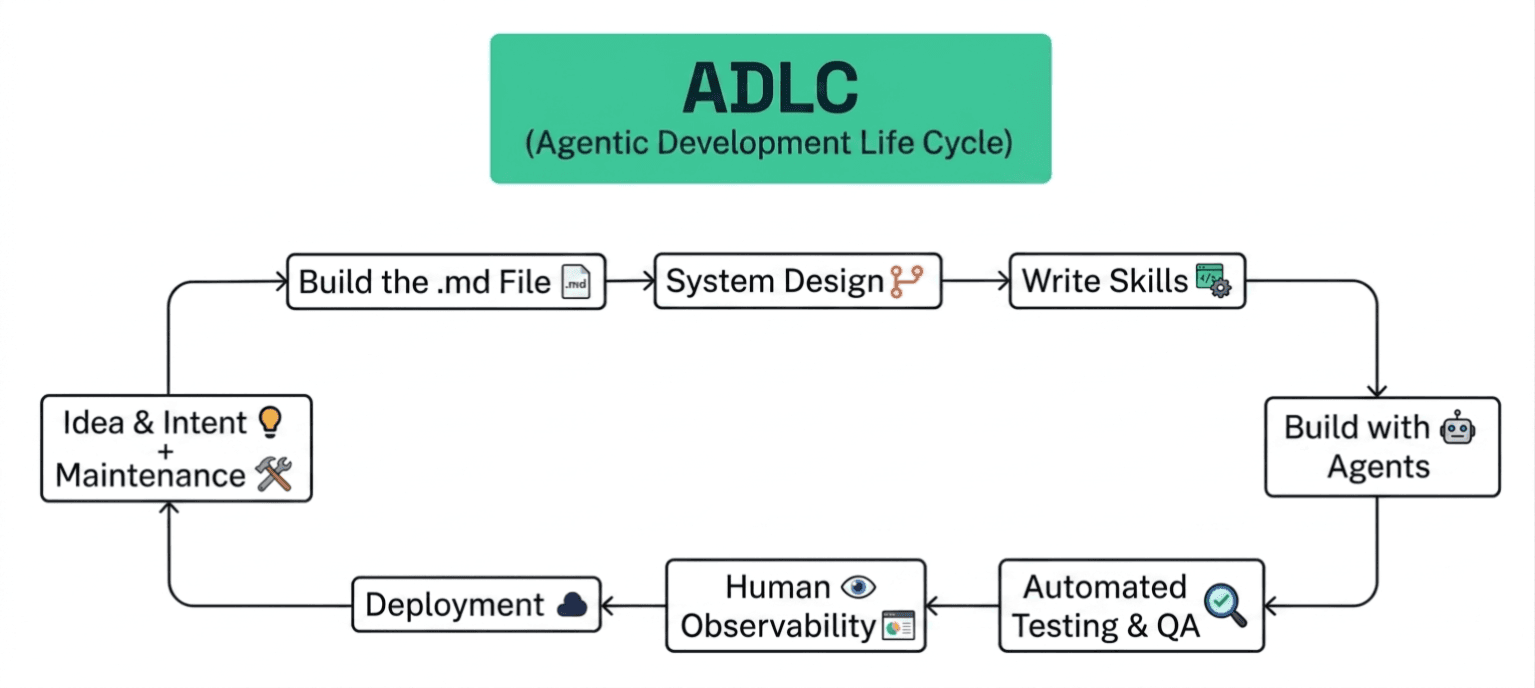
1. Idea & Intent
- Purpose: Define the agent’s purpose, scope, and intended outcomes.
- Process: This phase involves specifying the agent’s goals, the problems it will solve, and the boundaries of its autonomy. It’s about translating high-level ideas into actionable intents, often documented in a core .md file (like AGENTS.md or CLAUDE.md). This file acts as a "README for agents," providing operational guidance, constraints, and project-specific instructions for AI coding.
2. Build the .md File
- Purpose: Create a structured, machine-readable context file for the agent.
- Process: The .md file (e.g., AGENTS.md) is placed at the root of the project repository. It includes build commands, coding conventions, testing rules, and boundaries the agent must respect. This file ensures the agent understands the project’s context and operates within defined constraints.
3. System Design
- Purpose: Using Agent to design systems architecture, workflows, and interactions.
- Process: This phase involves mapping out how the system will interact with users, APIs, and other systems. It includes defining decision-making logic, data flows, and integration points. The design is often iterative, focusing on real-world scenarios and edge cases.
4. Write Skills
- Purpose: Develop modular, reusable skill sets for the agent.
- Process: Skills are packages of instructions, workflows, and resources that enable the agent to perform specific tasks. Each skill is typically defined in a SKILL.md file, containing YAML metadata (for triggers and context) and Markdown instructions. Skills transform a general-purpose agent into a domain specialist, allowing it to handle complex, specialized tasks without rewriting core.
5. Build with Agents
- Purpose: Use AI agents to write, test, and integrate code.
- Process: AI agents (e.g., Claude Code) read the .md and SKILL.md files and:
- Generate code based on the project’s requirements
- Run automated tests
- Integrate components
- Optimize performance The agents act as "coding teammates," handling repetitive tasks and accelerating development
6. Automated Testing & QA
- Purpose: Ensure the software is reliable, secure, and meets requirements.
- Process: AI agents automate:
- Unit and integration testing
- Static code analysis
- Security scans
- Performance benchmarking
This phase focuses on catching bugs early and ensuring the software behaves as expected.
7. Human Observability
- Purpose: Monitor the AI agents’ work and ensure transparency.
- Process: Humans review the agents’ outputs, intervene when necessary, and validate that the software aligns with the project’s goals. Observability tools track the agents’ actions and decisions
8. Deployment
- Purpose: Release the software to users.
- Process: AI agents assist in:
- Setting up deployment pipelines
- Configuring environments
- Monitoring rollouts
- Deployment is automated, with safeguards for rollback and continuous monitoring
9. Monitoring + Maintenance
- Purpose: Keep the software up-to-date and improve it over time.
- Process: AI agents:
- Monitor performance and user feedback
- Suggest updates or optimizations
- Automate patches and bug fixes This phase ensures the software remains reliable and evolves with user needs
SDLC vs ADLC: Phase-by-Phase Comparison
Structural Differences at a Glance
Traditional SDLC
- Core approach: Human-first execution
- Speed: Limited by team capacity
- Process structure: Linear
- Testing: Periodic
- Scaling model: Add people
- Optimization: Post-deployment
- Developer role: Builder
ADLC (Agent-Driven Life Cycle)
- Core approach: Human + agent collaboration
- Speed: Accelerated by agents
- Process structure: Continuous and iterative
- Testing: Continuous
- Scaling model: Add agents
- Optimization: Real-time
- Developer role: Orchestrator
Key Benefits of ADLC
1. Faster Time-to-Market
Development cycles shrink dramatically due to agent execution.
2. Higher Output with Same Team
Teams produce more without increasing headcount.
3. Continuous Improvement
Systems evolve in real time instead of waiting for updates.
4. Scalable Development
Growth comes from systems, not just hiring.
5. Shift in Developer Role
Developers move from:
- writing everything → guiding systems
Challenges and Risks of ADLC Adoption
Over-Reliance on Agents
Poor oversight can lead to:
- incorrect outputs
- hidden errors
New Security Considerations
Agent-driven systems introduce:
- prompt manipulation risks
- dependency issues
Skill Shift Required
Teams must learn:
- orchestration
- evaluation
- system design with AI
SDLC + ADLC Hybrid Models
Most organizations won’t replace SDLC.
Instead, they will:
- Keep SDLC for structure and governance
- Use ADLC to accelerate execution
This hybrid approach delivers:
- speed from agents
- stability from traditional systems
Frequently Asked Questions
What is the main difference between SDLC and ADLC?
- SDLC is human-driven. ADLC is human + agent-driven, enabling faster execution and iteration.
Why is SDLC slower today?
- Because it relies entirely on human effort, which limits speed and scalability.
Does ADLC replace developers?
- No. It changes their role from execution → orchestration.
How much faster is ADLC?
- AI-assisted development can reduce timelines by up to 40% or more, depending on the use case.