
TL;DR
- MCP is now stateless. No sessions, no sticky routing, no shared stores.
- Extensions framework lets Tasks and MCP Apps ship without changing the core spec.
- Authorization tightened: iss validation, credential binding, OIDC alignment.
- Roots, Sampling, Logging deprecated. 12-month migration window.
- Tier 1 SDKs (TypeScript, Python, Go, C#) shipped support July 28, 2026.
- Claude Code supports 950+ MCP servers, 400M+ monthly SDK downloads.
- Round-robin load balancers work now. No deep packet inspection needed.
What Is MCP?
MCP (Model Context Protocol) is an open standard that lets AI agents connect to external tools and data sources through a single protocol. Anthropic introduced it in November 2024. It defines three primitive types:
- Tools (functions the model can call),
- Resources (data the model can read), and
- Prompts (server-supplied templates).
Any AI client can discover and invoke capabilities from any MCP-compatible server.
Before MCP, every AI tool integration was custom. After MCP, one connector works across Claude, ChatGPT, Gemini, Cursor, VS Code, and dozens of other clients.
By mid-2026, the official MCP registry crossed 5,000 servers. The July 2026 update is the biggest revision since launch.
What Changed in MCP 2026-07-28?
Six Specification Enhancement Proposals (SEPs) delivered a stateless core, a formal extensions framework, and hardened authorization.
Stateless Protocol Core
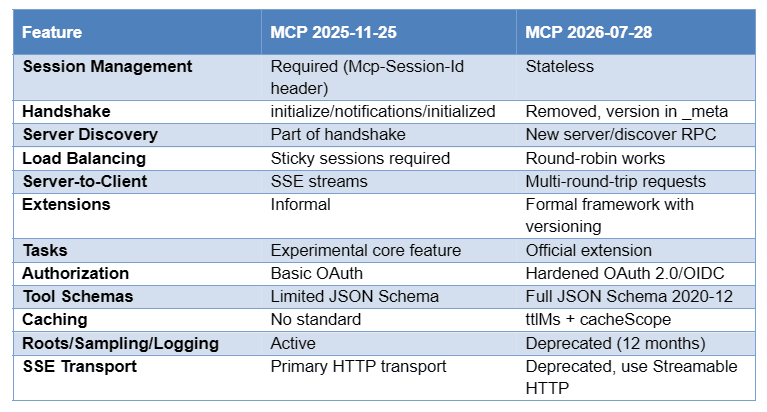
MCP is nowstateless. The initialize/notifications/initialized handshake is gone. The Mcp-Session-Id header is gone. Every request carries its protocol version, client capabilities, and client identity in _meta.
Before (2025-11-25): You established a session first. Every subsequent request carried the session ID, pinning you to a specific server instance.
After (2026-07-28): Each request is self-contained. Any server instance behind a load balancer can handle any request.
Extensions Become First-Class
Extensions existed in the previous spec but had no formal process. Now they use reverse-DNS IDs, an extensions map on capabilities, and independent versioning. Two official extensions ship:
- MCP Apps (SEP-1865): Servers render interactive HTML UIs in sandboxed iframes with security review before execution.
- Tasks Extension: Redesigned around the stateless model. Servers return task handles; clients drive them with tasks/get and tasks/update.
Authorization Hardening
Six SEPs align MCP authorization with production OAuth 2.0 and OpenID Connect:
- Clients MUST validate the iss parameter on authorization responses per RFC 9207.
- Dynamic Client Registration is deprecated. Use Client ID Metadata Documents instead.
- Credentials are bound to the issuing authorization server. Re-register when the server changes.
Routing and Caching
- Mcp-Method and Mcp-Name headers let load balancers route without inspecting JSON bodies.
- ttlMs and cacheScope fields on list results tell clients how long responses stay fresh.
- Deterministic tools/list ordering improves LLM prompt cache hit rate
What This Means for Coding Agents Like Claude Code
Coding agents benefit from the stateless architecture. Claude Code relies on MCP to connect to databases, APIs, file systems, and other development tools. Three things change:
Faster tool connections. No handshake means tool calls start immediately. A coding agent that invokes dozens of tools in a session saves the initialization round-trip on every one.
Serverless deployment. MCP servers can now run on serverless and edge infrastructure. Teams building custom MCP servers for internal tooling no longer need sticky sessions or shared state stores. Any instance behind a load balancer handles any request.
Better caching. With ttlMs on tools/list responses, coding agents cache available tools locally and refresh only when needed.
Claude Code lists 950+ MCP servers in its connectors directory. MCP Apps let servers render interactive UI in the conversation, useful for database query builders, API explorers, and visualization tools.
Old MCP vs. New MCP
What Enterprise Decision-Makers Should Know
What improved
The new spec fixes several enterprise pain points.
Scalability: Stateless architecture means horizontal scaling works out of the box. No shared session stores, no sticky routing.
Auth integration: Hardened OAuth 2.0/OIDC alignment lets MCP servers connect to Entra ID or Okta without workarounds.
Compliance: The formal deprecation policy gives enterprises a minimum 12-month window, so migration timelines are predictable.
Observability: W3C Trace Context propagation in _meta correlates distributed traces across SDKs and gateways.
What to watch out for
The rapid adoption of MCP in 2025-2026 created a real attack surface. Security researchers documented 30+ CVEs in MCP implementations in Q1 2026 alone.
- Tool poisoning (Invariant Labs, 2025): Malicious servers hid directives in tool descriptions that models followed silently.
- Cross-server contamination (GitHub MCP, 2025): A poisoned server tricked an agent into abusing tools on a legitimate high-privilege server.
- Exposed MCP servers (Backslash Security, 2025): Hundreds of public MCP servers bound to localhost with no authentication.
OWASP now tracks MCP-specific risks underLLM06 (Excessive Agency)and the Agentic AI Top 10.
What to do
- Use Tier 1 SDKs only. TypeScript, Python, Go, and C# are validated. Avoid unmaintained community SDKs.
- Audit your MCP servers. Every server your agent connects to is code you run. Treat them like any third-party dependency.
- Enable the new auth features. Validate iss on authorization responses. Bind credentials to authorization servers.
- Plan for deprecation. If you use Roots, Sampling, or Logging, start migrating now.
How to Get Started
- Update your SDK. Tier 1 SDKs (TypeScript, Python, Go, C#) shipped support July 28, 2026. Rust is in beta.
- Remove the handshake. Protocol version and client info travel in _meta on every request now.
- Update headers. Add Mcp-Method and Mcp-Name to Streamable HTTP requests. Remove Mcp-Session-Id handling.
- Handle MRTR. If your server returns InputRequiredResult, gather responses and re-issue the request with inputResponses.
- Test behind a load balancer. Deploy behind round-robin. Verify any instance handles any request.
- Enable caching. Add ttlMs and cacheScope to list and resource read results.
The Future of Tooling
MCP 2026-07-28 is the foundation the protocol will grow on. Stateless core means servers run anywhere: serverless functions, edge nodes, Kubernetes pods, VMs. Extensions ship on their own timeline without breaking core. Deprecation policy means enterprises adopt future revisions without rewriting transport code.
For coding agents, the direction is clear. Tools become more composable, more cacheable, more secure. MCP Apps bring interactive UIs into conversations. Tasks enable long-running background work. Enterprise-managed auth means zero-touch setup.
The protocol that started as an Anthropic experiment now has 400M+ monthly SDK downloads. Start with one MCP server. Update your SDK. The 12-month deprecation window gives you time, but the clock started July 28, 2026.